Tesla says the Cybercab was built with wheelchair users in mind, and put up a video to prove it. The seat claim holds up. Then watch who folds the chair.
On 27 August, Tesla’s Robotaxi account said the service had moved to 6am–10pm, seven days a week, with a larger unsupervised fleet and better routing. It now operates in Austin, Dallas, Houston, Miami, Orlando and Tampa, fully driverless in most of them. A seventh market, the San Francisco Bay Area, still carries a safety driver because California requires one.
A word on names, because they get used interchangeably and shouldn’t be. Robotaxi is the service: the app you book, the fleet that turns up. Cybercab is the purpose-built two-seat vehicle Tesla launched at an Austin event on 3 September. Most robotaxi rides today are still in a Model Y: Texas registration records from 2 September list 420 autonomous Teslas in that state alone, 375 of them Model Ys and 45 Cybercabs.
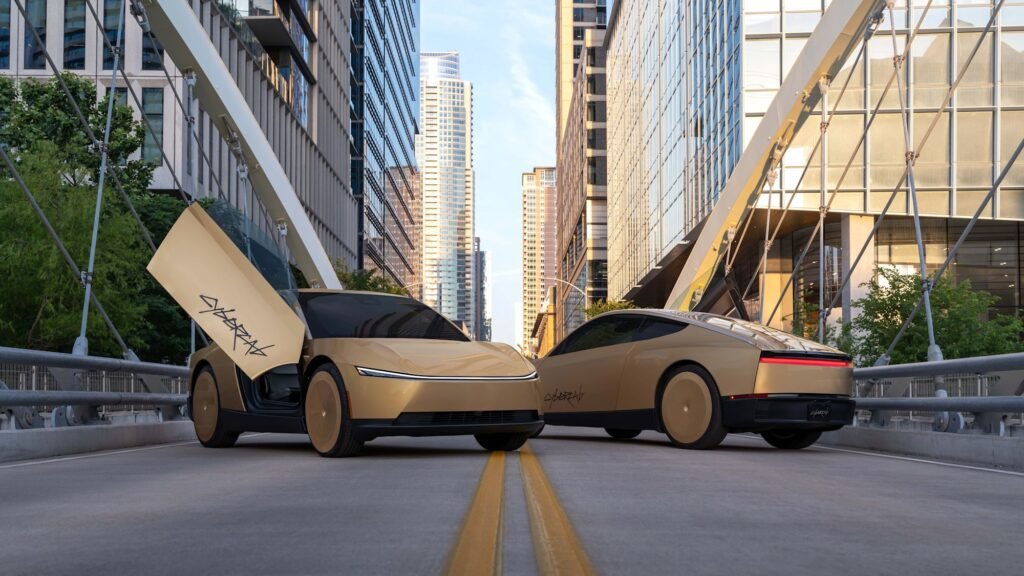
It’s a genuine milestone, and it’s smaller than it sounds. Waymo runs about 4,000 vehicles across 14 metros and does more than 500,000 paid rides a week. Tesla doesn’t publish ridership at all.
Tesla says it designed for this
On 5 September Anthony Sanchez posted a video of himself getting into a Cybercab, describing himself in the caption as a paraplegic. His verdict was “10/10”. Tesla’s Robotaxi account shared it the same day with an engineering claim of its own on top: that Cybercab seats “are built at standard wheelchair height, making ingress & egress easy”.
Here’s the ride, in Sanchez’s own words. It’s worth 30 seconds of your time before anyone tells you what it proves.
Using the @Tesla CyberCab as a paraplegic! 10/10!! @robotaxi #spinalcordinjury pic.twitter.com/bJA09kGKO2
— Anthony Sanchez (@Wheelchairpapii) September 5, 2026
Give Tesla the credit that’s due, because seat height is not a small detail. A seat that meets your chair at roughly its own height is the difference between a transfer that takes a second and one that isn’t worth attempting, and a low sports-car seat is close to the worst case. Sanchez gets himself out of the chair and into the car, and rates it a 10 out of 10. On the narrow claim Tesla is making, the video backs it up.
Then watch what happens to the chair. It’s folded and lifted into the boot by his brother.
That detail is the entire argument, and it’s sitting inside Tesla’s own showcase. The seat solved the transfer. A person solved everything after it, in a car whose whole proposition is that there is no person in it.
None of which is a knock on Sanchez, who went out for a drive with his brother the way anyone might. It’s a knock on the claim. “Ingress & egress easy” describes the part of the journey a wheelchair user does with their own arms, and skips the part that, in a driverless car, nobody is left to do.
It’s also worth noting the engineering claim comes from the manufacturer’s own account rather than any independent test.
Why disabled riders are watching this harder than anyone
If you’ve never had to think about it, the appeal of a driverless taxi is convenience. If you use a wheelchair, it’s something else entirely.
It’s a ride that can’t refuse you. Can’t sigh at the loading time, can’t decide your trip is too short to be worth it, can’t cancel when it sees the chair. No negotiating, no explaining, no being left on a kerb. That’s not a marketing benefit. For a lot of people it’s the difference between going out and not going out.
The part that isn’t on the poster
“Accessible” isn’t a yes or a no, and that’s where most of the coverage goes wrong. Riding one (Model Y or Cybercab) asks that you can transfer out of your chair unaided, that your chair folds, and that the chair gets into the vehicle somehow. Those are separate hurdles. Seat height helps with the first one. It does nothing for the other two.
A folding manual chair goes in easily enough, if there’s someone to lift it. But a rigid-frame or powered chair doesn’t fold at all, can weigh well over 100kg, and isn’t going anywhere without a ramp or a hoist.
And there’s the part that tends to get missed, the one the Sanchez video answers by accident. In an ordinary taxi, the person who loads the chair is the driver. Take the driver out and there’s nobody left to do it, the same absence that stops the car refusing you also removes the pair of hands you were relying on. Bring your brother and it’s a 10 out of 10. Travel alone and you are back to the question nobody has answered.
So the fleet works at the most mobile end of the disability spectrum, with help, and stops well short of the other. Said plainly: the robotaxi as it exists today is easier to get into than most cars, and still isn’t truly accessible.
Tesla’s own app says as much, in its way. Riders report it displays “Tesla is working on accessible rides,” illustrated with the Robovan, a vehicle that isn’t in service. You don’t build that screen for a fleet that already works for everyone.
Waymo is further along and the detail is still sobering. It does offer wheelchair-accessible vehicles, in San Francisco, Los Angeles and Phoenix. But by Waymo’s own description, that service exists “for people with mobility-related disabilities who cannot ride in our fully-autonomous cars”, and those accessible vehicles are driven by a person.
Read that again, because it’s the whole story. The largest driverless fleet on earth, and for the riders who’d gain the most from it, what turns up is a human behind a wheel.
None of this makes the technology a con. Purpose-built accessible autonomous vehicles are hard: securement points, ramps or lifts, and the fact that a robot can’t fasten your restraints for you. But it does mean the group with the most to gain is, for now, last in the queue.
Meanwhile, in Australia, the thing that already works is shrinking
We can’t get a robotaxi here yet. What we can get is a wheelchair accessible taxi, and there are fewer of them every year.
In New South Wales the number of registered wheelchair accessible taxis fell from 941 in October 2019 to 635 in October 2024, down about a third in five years. Lithgow, Ulladulla and Glen Innes have none at all. The incentive paid to a driver for a wheelchair trip has been $15 since 2016, while Queensland pays $25 and a wheelchair accessible taxi costs north of $110,000 to put on the road.
Queensland’s shortage was described as reaching “crisis point” back in 2023.
The lived version, from Sydney wheelchair user Pauline David, speaking to the ABC: “I waited one hour, two hours, three hours, and I realised I wasn’t getting a taxi.”
Ed Morris of the Physical Disability Council put the structural version plainly: “At the moment, we’ve got market failure, which is really disempowering the disability community.”
So when does a robotaxi turn up here?
Not soon, and the blocker isn’t the robot.
Australia still has no commenced federal Automated Vehicle Safety Law. It’s been targeted at 2026 for years, it’s still not in force, and a review back in 2016 counted around 700 regulatory obstacles across Commonwealth, state and territory law. Until that framework exists (including the requirement for an Automated Driving System Entity to be legally answerable for the vehicle’s behaviour), no commercial driverless service can operate here.
What you can buy today is Full Self-Driving (Supervised), which Tesla sells in Australia on subscription. Tesla’s own Australian support page is unambiguous about what it is: “None of these advanced driver assistance features make your Tesla vehicle autonomous or replace you as the driver.” You’re still driving. You’re just doing less of it.
What we’d actually watch
Three things, in order of how much they’d matter here.
A driverless vehicle completing a ride for a wheelchair user travelling alone, no driver, no brother, nobody else to lift anything. Better still, one that takes a powered chair, rolled on and secured. Not an announcement, not an app placeholder. A completed ride. Nobody has shown one.
The Automated Vehicle Safety Law actually commencing, which is the gate everything else in Australia sits behind.
And whether accessible service ends up written into the rules or left to goodwill. Washington DC’s robotaxi bill in July this year didn’t mention wheelchair access at all, which tells you how easily it gets left out.
The optimistic case is real, and a seat built to meet a wheelchair is a sign someone is thinking about it: a fleet that never refuses a fare, running at a cost that finally makes accessible transport economic, in a country that’s failing at it with human drivers. It’s just not here, it doesn’t yet carry the people who need it most without someone else along to help, and pretending otherwise doesn’t help anyone waiting three hours for a taxi that isn’t coming.
We’ll keep an eye on it.
New buying guides and robot news, whenever there’s something worth telling you about.
No spam. Unsubscribe anytime.
Sources
Anthony Sanchez (@Wheelchairpapii), 5 September 2026 · Tesla Robotaxi, 5 September 2026 · Tesla Robotaxi announcement, 27 August 2026 · Cybercab image courtesy of Tesla, Inc. · The Chargeport Robotaxi Tracker, September 2026 · Waymo Help, wheelchair-accessible vehicles · ABC News, wheelchair accessible taxis in NSW decline, 4 October 2024 · ABC News, Queensland WAT shortage, 16 April 2023 · Forbes Australia, when will robotaxis be allowed in Australia · Tesla Australia, FSD (Supervised)




One Response
Tesla has the robovan coming that should cater for wheelchairs without having to fold it.