Spring has arrived, the water is starting to warm and the cover is about to come off. If the cleaner is going to be replaced this season, September is when to do it — not the week before Christmas, when everyone else has had the same idea and the discounting has stopped.
Cordless pool cleaners have gone from a curiosity to the default recommendation in about three years. This guide is not a list of models — we have a separate one for that. This is the decision that comes first: whether cutting the cord is right for your pool at all, and what you give up when you do.
Most Australian pools are still cleaned by a suction-side cleaner crawling around on the end of a hose, powered by the filtration pump. It works. It has worked for forty years. The question is whether the newer battery-powered machines are actually better, or just newer.
You want the pump off
Your pool runs on a variable-speed pump you would rather not run for six hours a day, or it has no dedicated cleaner line. Cordless decouples cleaning from filtration entirely.
Your pool is simple and the pump runs anyway
A rectangular in-ground pool with a flat floor and a pump already on a timer. A $300 suction cleaner does that job and has almost nothing in it to break.
Your pool is big
Over roughly 12 by 5 metres, battery life becomes the constraint. A corded robot runs as long as you like from a powerpoint.
The four kinds of pool cleaner
Almost every cleaner sold in Australia is one of four things. The difference that matters is where the power comes from, and what that costs you to run.
| Type | Powered by | Typical spend | The catch |
|---|---|---|---|
| Suction-side | Your filtration pump, through a hose | $200–$700 | Pump must run while it cleans. No waterline work. Everything it picks up ends up in your filter. |
| Pressure-side | Return line, usually a booster pump | $700–$1,600 | Often needs a second pump installed. Good on leaves, weakest on fine silt. |
| Corded robot | Its own low-voltage supply at a powerpoint | $1,000–$3,000 | A floating cable in the pool. Runs independently of the pump and filters internally. |
| Cordless robot | On-board battery | $300–$3,000 | Cleans until the battery stops. Nothing in the water but the machine. |
The first two are not really cleaners in their own right. They are attachments that borrow power from your plumbing. That single fact explains most of what follows.
What cordless actually changes
Your pump stops being part of the job. A suction cleaner only moves while the filtration pump runs, so cleaning time and filtering time are the same thing whether you want them to be or not. A cordless robot has its own motors and its own basket. You drop it in, it works, you take it out. The pump can be off the whole time.
Your filter stops eating the debris. Everything a suction cleaner picks up travels down the hose into your skimmer basket and filter. Every leaf, every bit of sand. A robot keeps it in its own basket, which you rinse out with a hose. If you have ever backwashed a sand filter in January after a windy week, that is the difference you will notice first.
Walls and the waterline come into scope. Suction-side cleaners work the floor and, on a good day, the lower walls. The waterline scum line — sunscreen, pollen, dust — is a job you do by hand with a brush. Most mid-range cordless robots now climb and hold contact along the waterline. Whether they do it well varies enormously, and it is the spec most worth checking before you buy.
Setup goes from plumbing to nothing. No hose to cut to length, no flow valve to balance, no dedicated suction line needed. That matters most for above-ground pools, which frequently have nowhere sensible to plumb a cleaner in at all.
Where cordless falls down
This is the part most reviews skip, so here it is plainly.
A suction cleaner is a lump of plastic with a diaphragm in it. Very little to fail, and parts sit on the shelf at any pool shop. A cordless robot is a sealed battery, several brushless motors and a control board living in chlorinated water. When the battery degrades in three or four years, replacing it is often not economic — and on some models not possible at all.
Runtime is a hard ceiling. Cheaper units run 60 to 90 minutes. Mid-range machines land near 150. The longest-running cordless cleaners we cover manage about four hours — the Aiper Scuba S3 is rated at 240 minutes. If your pool needs more than one cycle to get clean, you are waiting hours for a recharge in between. A corded robot simply keeps going.
Retrieval is a genuine annoyance. A machine with no cord attached has to be got out of the pool somehow. Better models park themselves at the waterline when the cycle ends. Cheaper ones stop wherever the battery ran out, which may well be the deep end, and you will be fishing for it with a pole.
Nobody local repairs them. Suction cleaners are serviced by every pool shop in the country. Cordless robots go back to the manufacturer, and the Australian support arrangements for several brands are new enough that we would not want to make promises about them. Check the warranty terms and where the service centre actually is before you spend two thousand dollars.
What we cannot tell you: real battery life after three summers. These products have not been on the Australian market long enough for anyone to have honest long-term data, us included. Anyone quoting you a confident figure is guessing.
Running costs: the pump is the expensive part
Purchase price is the obvious number. Running cost is the one that quietly matters more, and it favours cordless by a wider margin than most people expect.
A single-speed pool pump typically draws somewhere between 0.75 and 1.5 kilowatts. Running one for the six-hour cycle a suction cleaner needs uses in the order of 4.5 to 9 kilowatt-hours. A cordless robot’s battery holds a small fraction of that, and charging it is measured in cents.
We are deliberately not putting a dollar figure on that. Australian electricity tariffs vary enough between states, retailers and time-of-use plans that a single number would mislead more than it helps. Look up your own rate per kilowatt-hour and multiply. On most bills the gap over a summer is meaningful — and if you are already on a variable-speed pump trying to cut pump hours, a cordless cleaner is the thing that lets you.
The saving is real but it will not justify a $1,500 machine on its own. Buy it because you want the pump off, the walls done and the debris out of your filter. Treat the running cost as a bonus.
Which suits your pool
Above-ground
Cordless, almost without argument. Above-ground pools rarely have a dedicated cleaner line, the walls are usually vinyl and the floors are flat. A basic unit like the Aiper Scuba SE is built for exactly this and nothing more — flat floors only, 90 minutes, done. Check the minimum water depth the model needs first, because shallow above-ground pools defeat some robots entirely.
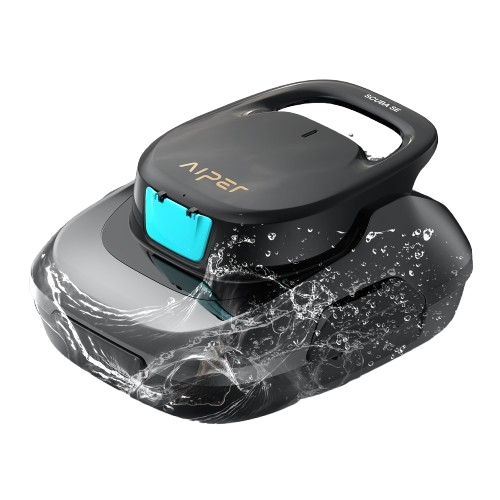
The cheapest way into cordless, and honest about what it gives up — it cleans the floor and nothing else. For a flat-bottomed above-ground pool that is the right match. For anything with a deep end or walls you want scrubbed, it is not.
In-ground under about 8 by 4 metres
Either works. A single cordless cycle covers it comfortably and you get the walls and waterline thrown in. If you already own a working suction cleaner and the pump runs on a timer regardless, there is no urgent reason to replace it.
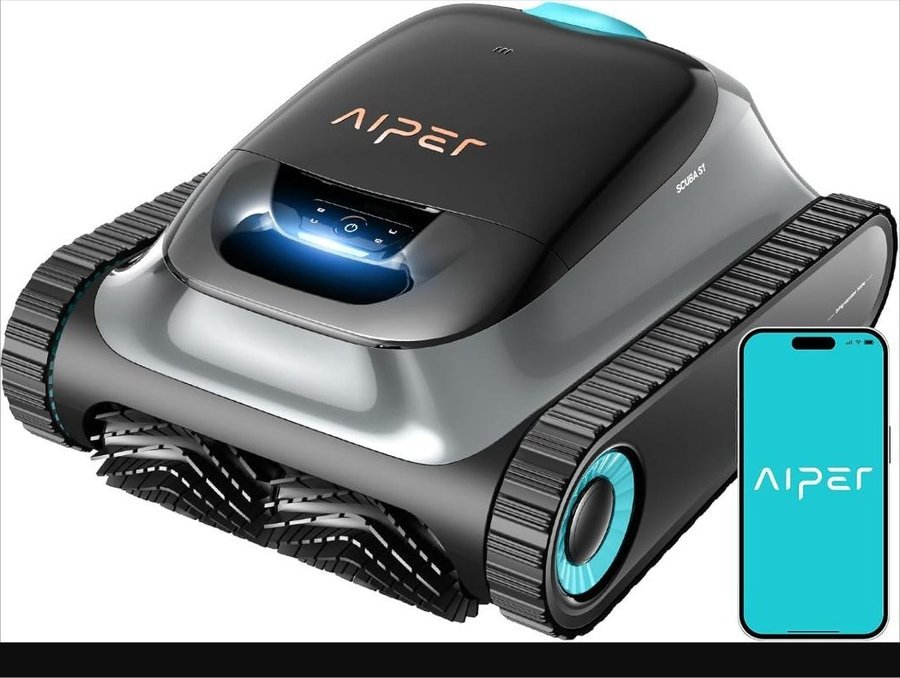
Aiper’s best-selling machine and the safe default for a standard in-ground pool. One cycle covers floor, walls and the waterline, which is the whole argument for going cordless in the first place.
In-ground over about 12 by 5 metres
Here cordless starts to strain, and you need to read the coverage rating rather than the marketing. Rated areas near 200 square metres exist — the Aiper Scuba X1 claims roughly that — but a rated figure assumes an empty, unobstructed pool. Steps, benches and a heavy leaf load all eat into it. A corded robot is the safer choice at this size.
Heavy leaf load
If you have gums or a jacaranda over the pool, basket volume matters more than the suction figure. A robot that fills in twenty minutes then pushes leaves around for the next hour is worse than useless. Consider a surface skimmer working alongside the floor cleaner — the Aiper Surfer S2 is a solar unit that catches leaves before they sink, which is the only real answer to that problem.
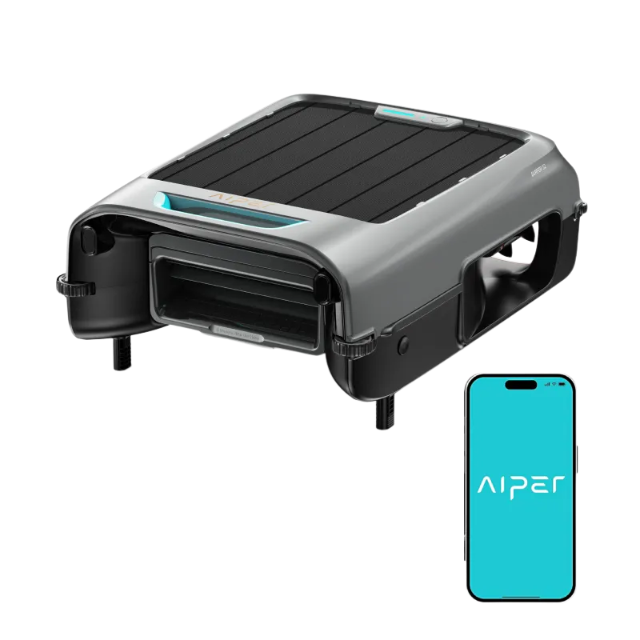
Not a floor cleaner and not a replacement for one. It works the surface all day on solar, catching leaves before they sink — which is the only real answer if you have gums or a jacaranda over the pool.
Three Australian specifics
Saltwater is fine, but confirm it. Saltwater is far more common here than in the northern hemisphere markets most of these products are designed for. Every cordless cleaner we list states saltwater compatibility, but read the wording rather than assuming, because a chlorinator pushes salinity higher than a manufacturer overseas may have designed around.
Buy in September, not December. Pool season runs November to March and demand climbs steeply through October. Stock thins and the discounting stops right when everyone wants one. If you are reading this in early spring, you are ahead of the rush.
Store it out of the sun. Lithium batteries hate heat, and an Australian pool deck in February is a hostile place to leave anything. Most manufacturers specify storage out of direct sunlight, and following that is probably the biggest single thing you control about how long the battery lasts.
Frequently asked questions
Are cordless pool cleaners actually any good?
The mid-range and up are genuinely good at cleaning. The honest reservation is longevity rather than performance — a sealed battery in a chlorinated environment is a harder engineering problem than a plastic suction cleaner, and the category is too young for anyone to have five-year data.
Do I still need to run my pool pump?
Yes. The pump filters and circulates the water, which is a separate job from picking debris off the floor. A cordless cleaner means you run the pump for filtration alone rather than filtration plus cleaning, which usually means fewer hours.
How long do cordless pool cleaners run?
Entry models around 90 minutes, mid-range near 150, the longest about four hours. Match that to your pool honestly — a machine that needs two cycles means a recharge wait in between.
Can I leave it in the pool?
No. They are designed to be removed, rinsed and stored between cycles. Leaving one submerged permanently is outside what any manufacturer specifies and will shorten its life.
Will it replace brushing the waterline?
Mostly, on a model that specifically claims waterline cleaning and holds contact rather than passing it in bursts. On models that only claim wall climbing, no — you will still be brushing the scum line by hand.
Cordless or corded robot?
Under roughly 12 by 5 metres, cordless. Above that, corded, because runtime stops being a constraint and a floating cable is a smaller annoyance than a half-cleaned pool.
If cordless is the answer
We have compared the cordless models sold in Australia on coverage, cycle time, shallow-water capability and what each one actually cleans in Best Robot Pool Cleaners Australia 2026. If you would rather just look at the range, the pool cleaning robots we cover are all here.
And if the answer is that your existing suction cleaner is doing the job and the pump was going to run anyway — that is a legitimate answer, and it is free.
Aiper come up a lot in this category, and their range is confusing on purpose. Our guide to the Aiper pool cleaner range works out which Scuba is actually worth the money, and names the three you cannot currently buy.
New buying guides and robot news, whenever there’s something worth telling you about.
No spam. Unsubscribe anytime.